
TLDR
Young team-sport athletes usually do not need to count every gram of carbohydrate. Start with regular meals, add a familiar snack when lunch and practice are far apart, and bring extra food for long competitions or multiple events. Fruit, grains, potatoes, dairy foods, sandwiches, cereal, crackers, and similar everyday foods can all contribute. Adjust the plan according to session length, intensity, schedule, hunger, and stomach comfort.
A useful way to approach carbohydrates team sport athletes fueling is to think in terms of gaps and demands rather than equations. When did the athlete last eat? How hard and long is the upcoming session? When will the next meal be available? Those questions lead to a more practical plan than copying an adult endurance protocol onto a growing middle- or high-school athlete.
The early answer is simple: eat enough across the day, include carbohydrate-containing foods at meals, and place an extra snack where the school and sport schedule creates a long gap. A one-hour light practice after a substantial meal is different from a hard after-school session following an early lunch. A tournament with several games requires another plan entirely.
Why carbohydrates matter in team sports
Soccer, basketball, football, lacrosse, volleyball, hockey, and similar sports combine lower-intensity movement with repeated accelerations, jumps, changes of direction, and high-intensity efforts. Muscle glycogen—the carbohydrate stored in muscle—is an important fuel source for this intermittent work. Building carbohydrate availability before extended activity and replenishing it afterward can support work capacity and recovery. The research does not mean carbohydrates guarantee faster sprints, sharper skills, or a win in every situation. A review of carbohydrate nutrition and team-sport performance explains both the role of carbohydrate and the sport-specific complexity.
This is why removing bread, rice, cereal, fruit, potatoes, or other carbohydrate sources can work against the demands of frequent practices. Carbohydrates are not the entire diet, but they are a useful part of fueling repeated high-intensity activity. Protein, fats, fluids, micronutrients, and sufficient total food still matter.
Start with the whole day, not the pregame snack
For an adolescent, food must support growth and development in addition to practices, games, physical education, and daily life. A perfectly timed banana cannot make up for repeatedly missing breakfast, eating a small lunch, and arriving at practice underfed. Inadequate energy intake relative to exercise demands can contribute to low energy availability, and low carbohydrate availability can be part of that problem.
A useful baseline is breakfast, lunch, dinner, and snacks as needed by the athlete’s schedule and hunger. Meals can combine a carbohydrate source with protein, produce, and a fat source. This does not require specialty sports food.
- Breakfast: oatmeal with milk, fruit, and eggs; or toast, yogurt, and fruit.
- Lunch: a turkey sandwich, fruit, vegetables, and milk; or a rice bowl with beans, meat, and vegetables.
- Dinner: pasta with meat sauce and salad; tacos with rice and beans; or chicken, potatoes, and vegetables.
- Snack: cereal and milk, fruit and yogurt, crackers and cheese, a bagel, or a simple sandwich.
Fruits, vegetables, whole grains, and dairy foods can help form the everyday eating pattern. Foods lower in fiber may sometimes be more comfortable close to demanding activity, especially when there is little digestion time, but that does not make higher-fiber foods undesirable during the rest of the day. Familiarity and tolerance matter.
Carbohydrates for team-sport athletes before activity
Several hours before activity, a normal meal with a substantial carbohydrate component gives the athlete time to digest. Closer to activity, a smaller carbohydrate-rich snack may be useful when the athlete is hungry, the previous meal was early, or the session will be demanding. American Academy of Pediatrics guidance describes a carbohydrate-forward meal roughly three to four hours before activity and a smaller snack closer to activity when needed.
Keep the final pre-activity choice simple and familiar. Large portions, unfamiliar foods, and meals especially high in fat or fiber may feel uncomfortable for some athletes when eaten immediately before running and jumping. Athletes should test snack options before ordinary practices rather than experimenting on a tournament morning.
After-school practice
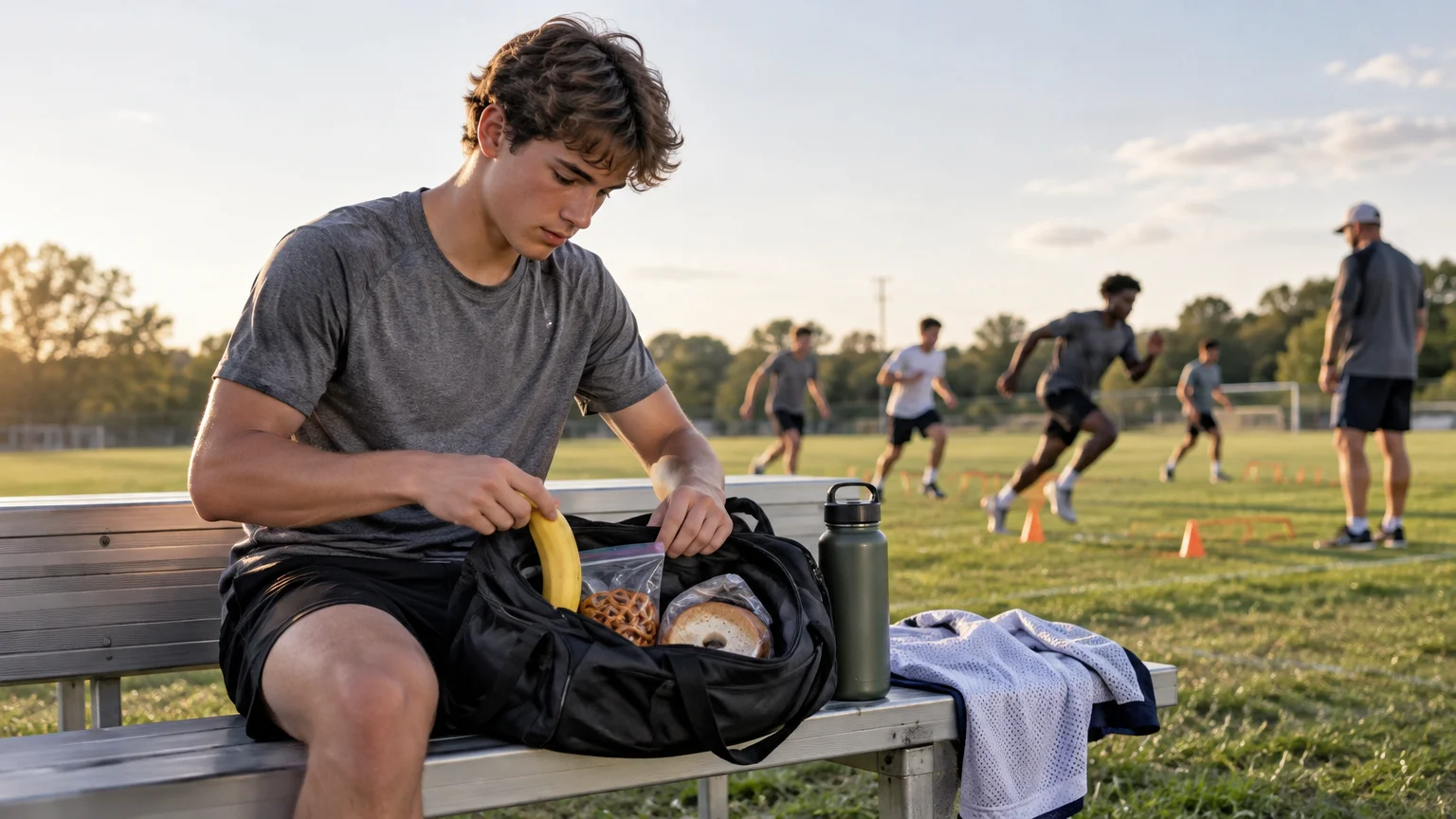
The most common problem is not a lack of sports products. It is the gap between an early school lunch and late-afternoon practice. Packing a snack creates a bridge. Options include a banana and pretzels, a bagel, dry cereal and fruit, applesauce and crackers, yogurt with granola, or half a sandwich. Athletes with only a short gap can choose a smaller, easier-to-digest option.
Early-morning games
If there is time, breakfast might be cereal with milk and fruit, oatmeal, toast with eggs, or a bagel with yogurt. When an athlete struggles to eat early, start smaller: toast, a banana, applesauce, dry cereal, or a drinkable yogurt may be easier. Pack another snack for after warmups or between games instead of forcing an unusually large breakfast.
Match the food plan to the session
| Situation | Practical approach before activity | Practical approach afterward |
|---|---|---|
| Light practice of about an hour or less | Regular meals may be enough. Add a snack if the athlete is hungry or lunch was several hours earlier. | Eat the next normal meal; use a snack if that meal is delayed. |
| Hard after-school practice | Pack a carbohydrate-rich snack to bridge the gap from lunch. Choose an amount the athlete can digest comfortably. | Have dinner or a snack containing carbohydrate and protein. |
| Long practice or extended game day | Eat a familiar meal beforehand and carry portable carbohydrate-rich foods. | Refuel between events when possible and eat a balanced meal afterward. |
| Tournament, doubleheader, or two-a-day | Plan several familiar foods instead of relying on one large meal. Account for travel and limited food access. | Use snacks between sessions and follow with a regular meal when the schedule allows. |
A separate exercise snack is not essential for every light practice lasting about an hour or less when regular meals are already in place. The decision depends on hunger, time since the previous meal, and when the athlete can eat next.
Demanding practices and long competition days call for more planning. Bring several options so the athlete can eat manageable amounts between events: fruit, pretzels, cereal, bagels, crackers, sandwiches, applesauce pouches, or yogurt kept safely cold. Research supports carbohydrate availability for extended intermittent activity, but exact during-exercise plans for youth should be individualized rather than borrowed from adult athletes.
Tournament planning also includes logistics. Put snacks in an easy-to-reach pocket, use an insulated bag for perishable foods, and label bottles and containers. A theoretically ideal snack cannot help if it is buried under equipment or left in the car. Families juggling school, training, and travel may also benefit from these back-to-school planning tips for high-school athletes.
Recovery does not have to be a special shake
After exercise, carbohydrate-containing food begins replenishing glycogen. The next normal meal can handle much of this job. When dinner is delayed or another session is coming soon, a recovery snack becomes more useful.
- Chocolate milk and a banana
- Yogurt with fruit and granola
- A turkey sandwich and fruit
- Cereal with milk
- A rice bowl with chicken or beans
- Crackers, cheese, and applesauce
- A smoothie made with familiar ingredients, plus toast if the athlete needs more food
Including protein in the snack or meal supports the broader recovery process, while carbohydrate restores fuel. The point is not to find one perfect ratio. It is to eat something practical and then return to a normal meal pattern.
Sports drinks, gels, and carb loading
Sports drinks and gels are tools, not routine requirements. Water and ordinary food are usually the simpler starting point for a standard youth practice. A sports drink may be practical during prolonged activity, hot conditions, tournaments, or situations where breaks and solid food are limited. Whether it helps depends on session demands, heat, food access, and the athlete’s tolerance.
Carbohydrate loading is also not a standard high-school game strategy. AAP guidance does not recommend it for shorter competitions or high-school-level athletes. A large, unfamiliar pasta meal the night before a game is more likely to complicate the routine than compensate for several days of inconsistent eating.
Supplements should not become a shortcut around regular meals. The International Olympic Committee advises a full nutritional assessment before supplement decisions and identifies health, contamination, and anti-doping concerns. Families considering powders, pre-workouts, or mass-gain products can review the broader issues in this guide to supplement use among high-school athletes.
Use feedback instead of rigid gram targets
Detailed carbohydrate protocols often come from adult research. Children and adolescents differ physiologically, and the youth sports-nutrition literature identifies a need for more age-specific research. That makes a flexible process more appropriate than handing every minor the same grams-per-hour or grams-per-kilogram target.
Over several practices, note a few practical signals: Was the athlete hungry before warmups? Did the snack sit comfortably? Was energy reasonably steady through practice? Could the athlete eat afterward? Did the plan work with school and travel? Change one variable at a time, such as moving the snack earlier or choosing a smaller, simpler food.
Persistent fatigue, recurrent illness or injuries, restrictive eating, notable weight changes, or menstrual changes deserve individualized evaluation rather than a home fueling experiment. A pediatric clinician or qualified sports dietitian can assess the full picture, including growth, health, total energy intake, training load, and possible medical concerns.
A simple next step
Look at the athlete’s next training day and find the longest gap between a meal and practice. If that gap is substantial, pack one familiar carbohydrate-rich snack and a backup option. Then make sure a normal meal or snack is available after activity. That small amount of planning covers most everyday fueling situations without turning food into math homework.
References
- Carbohydrate Nutrition and Team Sport Performance – PubMed
- Carbohydrate ingestion during team games exercise: current knowledge and areas for future investigation.
- 2023 International Olympic Committee's (IOC) consensus statement on Relative Energy Deficiency in Sport (REDs) – PubMed
- 2023 International Olympic Committee’s (IOC) consensus statement on Relative Energy Deficiency in Sport (REDs) | British Journal of Sports Medicine
- Tips to Support Healthy Routines for Children and Teens | Healthy Weight and Growth | CDC
- My 16-year-old started using a supplement before working out and says that “dry scooping” makes it work better. Is this true? – HealthyChildren.org
- Sports Nutrition for Busy Families and Busy Lifestyles – HealthyChildren.org
- Carbohydrate intake considerations for young athletes.
- Carbohydrates for Energy – HealthyChildren.org
- IOC consensus statement: dietary supplements and the high-performance athlete.
